
After taking a few weeks off Dev Diaries, I return to you today to discuss Historical Events. Historical Events are essentially pre-scripted events that will take place during the game mirroring some major events that took place in history.
At one point, I wanted to forgo scripted events altogether in favor of a more dynamic approach, where “history-like” events would naturally occur in response to the overall game state. This idea occurred to me late in development, however, and trying to create a system like that would have set me back at least a few months (perhaps in a sequel?).
My approach to events is fairly minimalistic. Each event will take place sometime between two dates. Some events will only fire with some probability, so they will not occur in every playthrough. The number of events is fairly small, most of them concern major shake ups such as the Revolutions of 1848, the Greek War of Independence, and the Meiji Restoration. Their purpose is to add a bit of flavor to the game while also helping to make the game feel more like you are going through something like real World history.
Events come in the following:
- Political Reforms: This event results in a nation changing its form of Government.
- Famine: This event results in more provinces failing to produce food for a round.
- Uprising: This event in a nation breaking free of its current rulers, forming a new nation.
- Military Reform: Removes the “Gross Military Corruption” status that some nations have at the start of the game.
- Modernization: Results in a traditional nation being reclassified as a modern nation.
- Annex Sphere: Results in a Sphere being formally annexed by the sphere holder.
Liberation Casus Belli: Results in gaining a casus belli to liberate a nation from another nation.
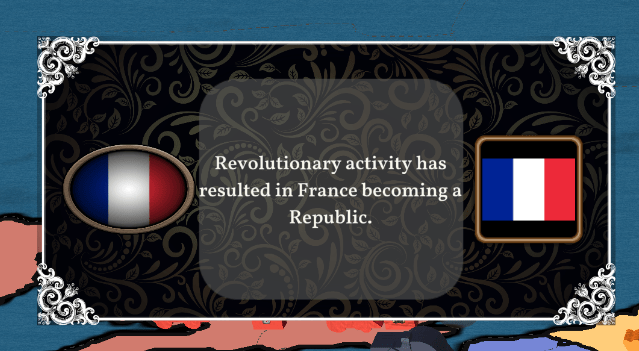
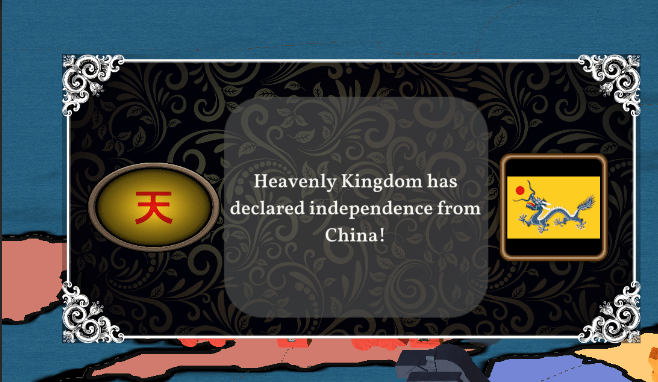
Some events result in a Crisis, prompting a meeting of the Concert of Europe. It is typically an Uprising or Annex Sphere event that will result in a Crisis. In a Crisis there will be two sides, for example it would be the Ottoman Empire and Greece in the case of the Greek War of Liberation event. Each great power can choose to join either side or to remain neutral. Picking a side wins you a Prestige point, but introduces a risk of getting into a war.
If the aggressor side (i.e., the side that might want a war) is clearly outclassed in the Concert of Europe, it will back down and war will be averted. If, however, the aggressor believes they can win, they will go to war. Those nations who committed to either side of the Crisis are immediately involved in the resulting war on their respective side.

At the moment, there are only about 23 events in the game. That number will probably increase, but not by a lot. Imperialism: Concert of Europe is not a historical simulator, it is not indeed to recreate actual history in any degree of detail, but it does try to trace out the broad outlines.

 Imperialism: Concert of Europe
Hi, I like the idea of events and I think, that 23 events are enough. Especially as not every event will take place and some maybe occur as a positive or negative follow-ups. e.g. instead of a Famine there could also take place a bounty harvest providing more food.
In IMPERIALISM there are small events like:
-Diplomacy status worsens to another nation due to a funny event
-you receive one extra military unit
-Miitary units start with one level experience more
LikeLike
Thanks for the comment and the event suggestions.
Adding some more random events for improving or worsening relations between nations sounds like a good idea.
Giving Japan an extra military unit when it modernizes would help as well.
LikeLike