Dev Diary Seven: Government Types and Technologies

Why am I discussing government types and technology in the same Dev Diary? Government type is a pretty simple feature in Imperialism: Concert of Europe, but it has a significant impact on some other systems, and on technology research in particular. 

There are several government types in Imperialism: Concert of Europe: 

  • Tribalism
  • Feudalism
  • Absolute Monarchy
  • Constitutional Monarchy 
  • Republic

Communism might later be introduced as a possibility, but for the moment it is not. Game mechanically, Constitutional Monarchy and Republic are the same, the difference being only cosmetic. 

Government types do not really affect the player’s decision space, because you do not have control over what government type you have. Each nation begins with a government type, and the government type of some nations will change during the game in response to scripted historical events (most notably the Revolutions of 1848). The main purpose of having government types is to prevent nations like China and Persia from becoming as technologically advanced as nations like France and Germany. Historically there were, of course, many reasons why the great divide in technological advancement occurred between the West and the rest of the world, and scholars disagree on which factors are most important. Since this game is not intended to be a simulation, much less a PhD thesis, I have chosen to err on the side of simplicity. A nation’s government type and any events that might change that type, effectively  make some nations more difficult to play as than others.

Most playable nations will begin the game as an Absolute Monarchy. The United Kingdom and Netherlands, however, have the advantage of having Constitutional Monarchy from the beginning.

The government type of a nation affects the efficiency of most of its middle class pop units. Recall, in the last Dev diary we mentioned that each Engineer pop generates a number of research points each turn, and that number depends on the government type of its nation. Likewise, Bureaucrats and Officers are more effective in, for example, a Constitutional Monarch than in a Feudal nation.  

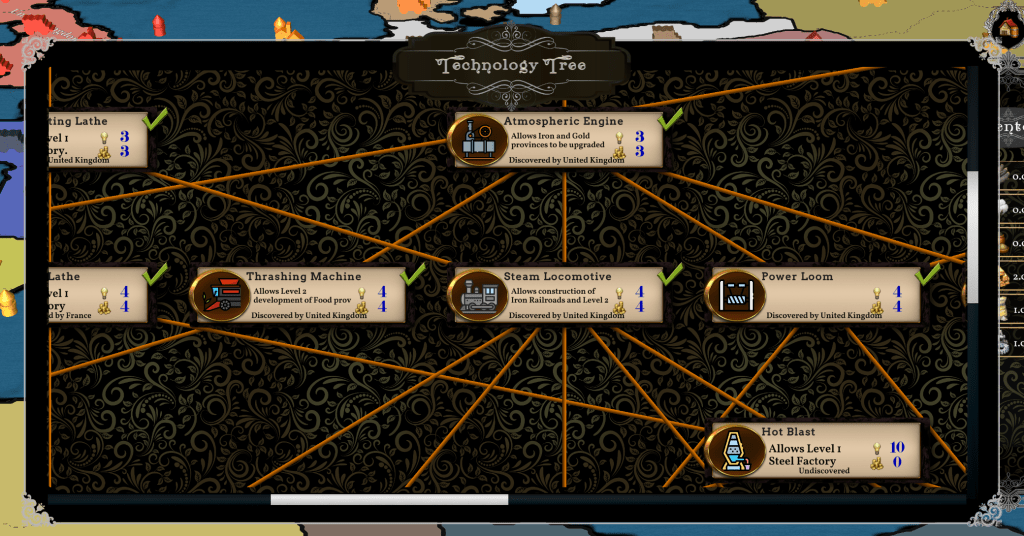
So much for government types, what about technology and research? The technology tree Imperialism: Concert of Europe is pretty standard in most respects. As usual, the tree itself is structured based on prerequisite dependencies. Each turn you collect research points from your Engineers and once you have enough points to get a new technology, you spend those points to get said technology. 

There is one respect in which technology research in Imperialism: Concert of Europe from other games I have played, and that concerns patents. The first nation to research a technology gets a patent on that technology. This comes with two benefits and one drawback. The first benefit is that the first nation to research a new technology gains one Prestige (i.e. a victory point). The second benefit is that all other nations will have to pay that nation a gold fee when they research it. The drawback of being the first to discover a technology is that you must pay the full Research Point cost, while all other nations will pay only half that cost (but must pay the gold fee as well). This makes the race for technological supremacy lucrative for both Prestige and wealth and also makes it less likely that there will be a large gap in the technological advancement of advanced nations.

There is also a tech-spread mechanism, whereby a technology will be known by all Modern nations some number of years after it is first discovered.  

What do technologies do? Well, mostly the sort of things you might expect. Technologies can have the following effects:

  • Unlocking factory types and upgrades to those factories.
  • Allow construction of railroads (first iron, then steel).
  • Allow upgrading provinces so they can produce more resources (three levels).
  • Improve military units.
  • Unlock unit types: Ironclads, Dreadnoughts, Fighters, and Tanks. 
  • Discover new resources: rubber and oil.
  • Lengthen the lifespans of your population units.  

There are a few technologies that are really just prerequisites for others, but they reward some Prestige to compensate for this.

Below are some pictures of the tech tree. Nete that this is one aspect of the UI that is likely to be significantly revised between now and the final release.

Dev Diary Six: Population

Most things that a nation does are done by the people who populate that nation, and Imperialism: Concert of Europe is no different. You will certainly want to invest in infrastructure and factories, but your biggest investment will be in your people. Most actions you make while administrating your nation are done using population units.

Each unit of population has a profession, an ethnicity, a religion, and years active. The most important of these is the profession, as this determines what it can do for you. Professions, in turn, are divided into two categories: lower class and middle class. 

  • Lower Class
    • Laborers 
    • Soldiers
  • Middle Class
    • Bureaucrats
    • Engineers
    • Officers
    • Managers
    • Artisans

You create population units by spending goods. As of this writing, lower class pops cost 4 food, 1 clothing, and 1 beer. Middle class pops cost 6 food, 1 clothing, 1 paper, 1 spice, and 1 tea. Every pop will exist for a certain number of years based on the level of your medical technology, but at a minimum of 28 years. This is effectively how many years the pop is in the workforce.

Laborers form the backbone of your economy. Their most important role is in operating factories. Whenever you want to activate a factory, you must have a free laborer that you can assign to it. Laborers are also needed for building factories, railroads, forts, and fleets. 

Soldiers are employed to create army units. Each soldier population supports one army unit. When the underlying soldier “retires”, the army it supports will be removed from the game. When an army unit is destroyed in battle, the underlying population unit is killed.

Bureaucrats are required to administer your provinces. Each bureaucrat pop generates a certain amount of bureaucratic capacity depending on the type of government held by its nation. The cost to administer a province will increase with its level of development. Bureaucrats might also be required to get the benefits of healthcare, but this has yet to be implemented and might not get implemented. 

Engineers are required to research technologies. Each turn, each engineer unit will produce Research Points. The number of points generated is based on the form of government of its nation. These points are used to purchase technologies from the tech tree.

Officers are similar to soldiers, in that they enable the creation of army units, but with the following two additional benefits. First, the units they create are a bit stronger than regular units. Second, each officer produces Doctrine Points each turn, again based on the government type of its nation. These points are used to develop military doctrines, which are similar to technologies, and represent the level of training of your armies and the sophistication of their logistics and planning.   

Managers are required to manage factories. Each manager effectively manages three factories, rounded down (i.e., you can activate up to two factories before creating any managers).

Artisans are required to create goods without factories. Some advanced goods, such as telephones, can only be made in factories. In the early game, most production is done using artisans, but as the game progresses, they will be replaced by laborers in factories, which can produce goods in much larger quantities. 

In the late game, middle class pops can be upgraded by spending one unit of Telephones and one unit of Automobiles. This will double the points that they produce. Artisans, however, cannot be upgraded. A nation also gains one prestige (i.e. Victory Point) when upgrading a pop, making pop upgrading important for winning the game.

Dev Diary Five: Negotiating Colonization Claims

In the previous Dev Diary, we  looked at Imperialism: Concert of Europe’s Influence mechanics. Perhaps the most important use of Influence was to influence Traditional Minor nations in the hope that an “incident” will occur, which will allow the influencer to press its colonial claim on the target nation. How does this occur? Whenever such an incident occurs, a Concert of Europe Congress will be held. All colonial powers (all nations with the ability to colonize) are invited to the congress. 

Explaining the mechanics of the Colonial Congress is a bit awkward, but it is simpler than it might initially appear. This difficulty in explaining is partly due to the Colonial Congress being perhaps the most original aspect of the game. I am not aware of any game having anything quite like it.

In order to have a colonial claim recognized by the Concert of Europe, at least 51% of the colonial nations, weighted by their naval strength, must recognize that claim. Each nation’s voting power is equal to its percentage of the total naval power of all colonizing powers combined. This is measured not by the number of fleets each  nation possesses, but on the total power of its combined fleets. Accordingly, improving fleet strength with naval technologies and military doctrines will increase the number of votes a nation has during a Colonial Congress meeting. Also, Dreadnaught fleets contribute far more voting power than Frigate fleets.

When attempting to have a claim recognized, the claimant nation automatically votes in favor of itself, so nations with powerful navies will not require as many votes from other nations. Each of the other colonial powers will make one or more recognition request that they would demand in exchange for granting the claimant colonial recognition of the targeted nation. Nation A granting colonial recognition of Nation C to nation B, has the following implications:

  1. If Nation B ever requests recognition of C in a future Congress, A automatically votes in favor of B’s claim.
  2. If some Nation D ever requests recognition of C at a future Congress, B cannot vote in its favor of D’s claim.
  3. Nation A cannot influence Nation C, and any influence tokens it currently has on C will be removed (but can be placed elsewhere on A’s next turn).
  4. Nation A cannot grant recognition of C to any other Colonial Power at any future congresses.

Some of the other nations will refuse grant recognition either because they wish to gain that colony for itself, or it cannot find a request to make that it believes is worth the votes it has to offer. Nations with more voting power will generally make greater concession demands than those with less voting power. For example, Portugal’s recognition of claims are not of much value to the UK, so the UK would only recognize a claim made by Portugal if Portugal were to recognize the UK’s claim on several other Traditional Minor nations. 

The claimant nation will try to accept enough requests to get at least 51 votes in total. Sometimes this will not be possible, and the claimant will fail to obtain colonial recognition of the target nation. When a deal is made, the claimant will recognize the claims requests of those it had chosen to reach 51 points. 

Sometimes, by the time a Colonial Power has an opportunity to make a colonial claim, it will have already obtained 51 or more votes in favor of recognition. In which case, that power just has to wait for an incident to occur to receive its colonial claim.

After obtaining recognition, the claimant nation will have a colonial casus belli on the target. Making the target into a colony can then be accomplished by defeating it in a war. 

Dev Diary Four: The Power of Influence

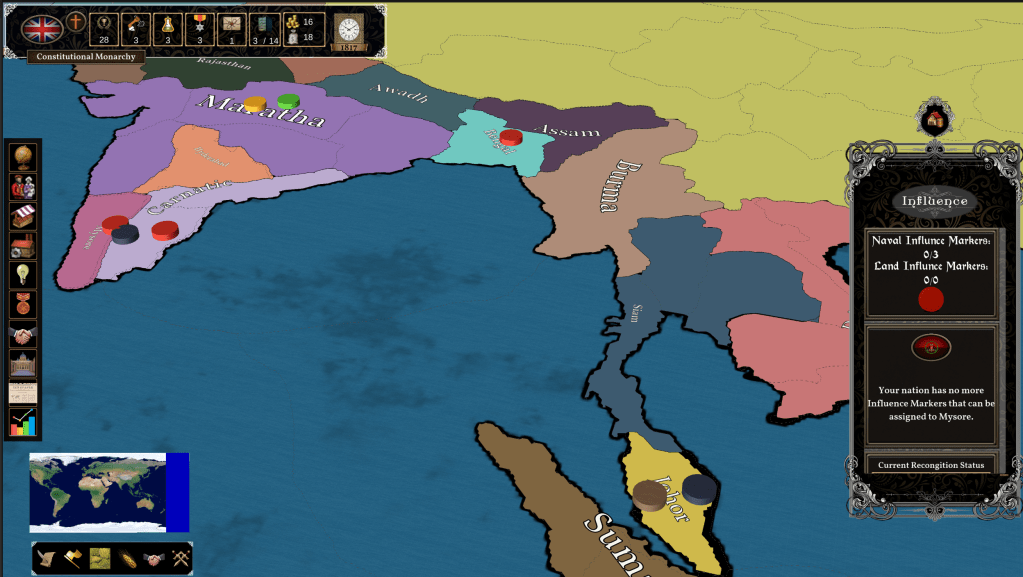
In Imperialism: Concert of Europe, nations are able to influence each other with various results. Influence is propagated by placing Influence Tokens on the Nation you wish to influence. What determines the number of influence tokens you have? For each Army unit a Nation possesses, it may place one influence token on a nation that borders your home territory. For each Navy unit you possesse, you may place one influence token on a nation that can be reached overseas (i.e., either it has a port or it borders one of your colonies). Each Dreadnought Unit grants two influence tokens, because Dreadnoughts are bad-ass.

What does influence achieve? This is context sensitive. It depends on what sort of nation is influencing and what kind of nation is being influenced (See the previous Dev Diary on unit types).

The most important use of influence is to gain colonies. Traditional Minor nations, such as Sumetera and Namibia, can be colonized by Modern nations. The first step is to place at least one influence token on the target. Each round, there will be a 1 in 10 chance that an “incident” will happen involving your interests in that nation, and this allows the Modern nation to call a Concert of Europe meeting to request recognition of its claim to colonize the targeted nation. Gaining recognition will require granting recognition of claims made by other Modern powers, but we will go into greater details on that in a future Dev Diary.

Russia is a special case. Russia cannot gain colonies, but it is permitted to annex any traditional minor power with which it shares a land border. This allowed Russia to gradually swallow up Central Asia. 

Influence can also be used by Major Modern powers to place Minor Modern powers in the Sphere of Influence. Each round each influence token will have a 1 in 10 chance to result in gaining the targeted nation as a sphere. Once a nation is sphered, there is a cool-off period during which other nations cannot influence it. Nations in your sphere of influence will prioritize trade with you over all other nations and will always join you when you are in a major war.

When influence is placed on a Major Traditional power such as China or Persia by a Major Modern power, the result will be to gain a casus belli to impose Free Trade on that nation. 
A final use of influence is to gain a casus belli on a nation to take a province from the target. This is only possible when the influencer already has a claim on the province. Russia, for example, gets a claim on Outer Manchuria and so it can place an influence token on China until an incident happens, then declare war on China.

Dev Diary Three: Four Nation Types

This short Dev Diary will introduce you to the four different nations types in Imperialism: Concert of Europe.

  • Great Powers are major modernized nations such as France, the United Kingdom, Russia, and Austria. These are the nations the human player is generally expected to  play, and the game is designed assuming that one of these nations will normally be chosen. These nations have at least five provinces, with Russia having far more. These  nations begin with technology allowing them to begin industrializing at the start of the game, but Russia will be a little bit behind the rest. Great powers can colonize minor traditional nations and can sphere minor modern nations.
  • Minor modern nations include all European nations that are not Great Powers, such as the Netherlands, Sweden, and Spain. The player can play as some of these nations, namely those that have some potential to gain colonies or to grow. These nations can have colonies but cannot have spheres (as they are spheres). The playable minor modern nations are a good choice for players who want a challenging game experience.
  • Old Empires are major traditional nations, such as the Ottoman Empire and Qing China. Japan begins the game as an Old Empire but will become a Great Power after the Meiji Restoration event. Old empires cannot be colonized, but some of them can lose some provinces to Russia. The human player can play as the Ottoman Empire or Japan. China and Persia may or may not be playable in the final game.  
  • Minor Traditional nations include all non-European nations that are not old empires, and make up the majority of nations in the game. These nations can be colonized. Some of these nations can be colonized from the beginning of the game (most of India, the East Indies, and Cape), another group becomes available for colonization at the start of the Middle Era (1848) and the remaining become available at the start of the Late Era (1881). The human player cannot play as any of these nations.