
Many of the core game mechanisms of Imperialism: Concert of Europe are broadly economic in nature. The game begins in 1815, just after the defeat of Napoleon. The Industrial Revolution is just beginning to gain steam.
The foundation of the economy consists of resource collection from the provinces you control. Each province generates one kind of resource, such as Wood or Dyes. Each province has a Quality level, which determines the base level of how much of its resource it produces. A province must have Roads and basic development in order to generate this base level of production. Unless you play as Russia, all of your provinces should already have this base level of development. Provinces with Level 2 Development and Iron Railroads will produce twice its base production. Provinces with Level 3 Development and Steel Railroads will produce four times its base production. Sometimes famine or riots will interfere with resource production.
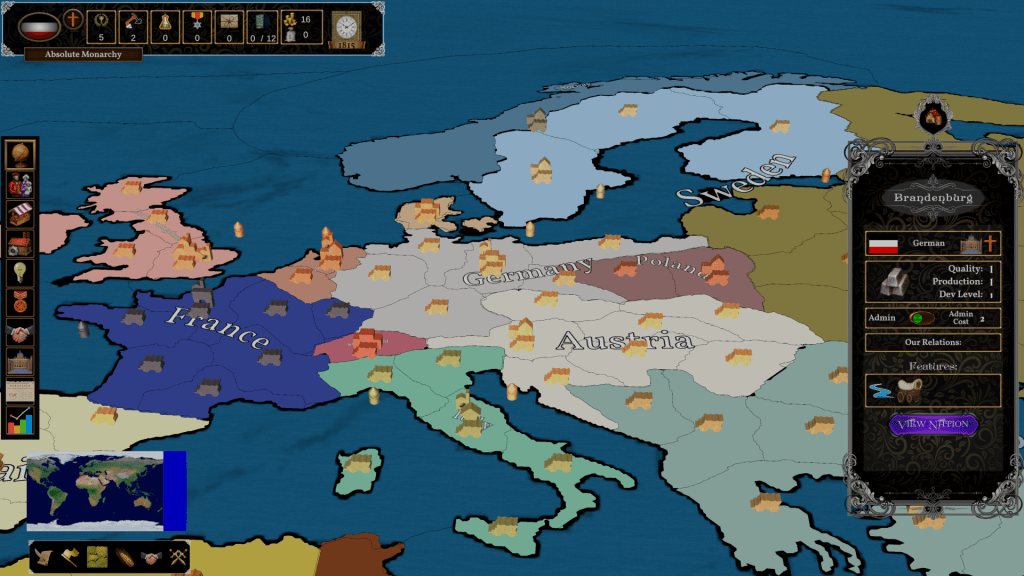
Some resources, such as Food, Coal, and Tea, are not in need of any additional work in order to be useful, but many resources are used as the base materials of manufactured goods. At the start of the game all or nearly all manufacturing will be done by Artisans in Workshops. One Artisan can manufacture one Unity of a good per game round. Factories allow greater production, where each Laborer will produce at least three or four units of its good type, and this will increase to seven or eight once factories have been upgraded and electrified.

It is likely that in the early part of the game that you will need to spend the most attention on developing your industrial capacity and feeding your factories with their required inputs.
The World Market is a central part of the game. Each round you can make offers to sell things on the market or make bids to buy things. During round processing, bids and offers are matched up based on the relations between the respective nations. For example, if there is a sellers market for Clothing (i.e., there are more bids for Clothing than offers), each seller will begin selling their offers beginning with the nation with which it has best diplomatic relations. Likewise, if the market for Clothing is a buyers market (i.e., there are more offers for clothing than bids) each bidder will buy from the nations with which they have the best relations.

In Imperialism: Concert of Europe, gold is money and only a few provinces produce gold. Hence, often your only source of income will come from selling resources and manufactured goods on the market. Likewise, domestic actions require goods and labor, but they do not require gold, so the only thing you need money for is buying things from the market. Even with colonies, it will usually not be possible to domestically produce all resources, at least not in sufficient quantities, so trade is necessary for success.
There will later be a diary on Colonization, but as far as their economic impact is concerned, you gain 50% of the extracted resources from colonial provinces, the colony itself keeps the other half, but you will be their most favored trade partner.
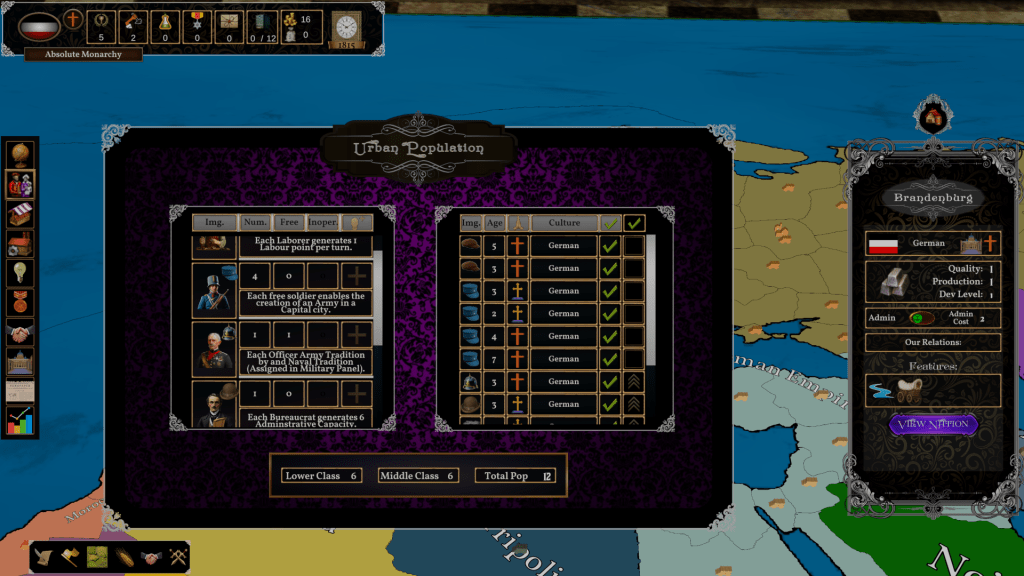
What are goods good for? They are needed to build factories, develop provinces, build fleets, and, most importantly, they are needed to create Population units, which are really the backbone of your nation. For example, creating a Laborer Pop (currently) costs 4 Food, 1 Clothing, and 1 Beer. Middle class Pops, such as Engineers, have additional costs, including Paper, Tea, and Spice.

 Imperialism: Concert of Europe